Please see my latest Life Coaching video which focuses on Rotter’s (Circles of Influence and Control) along with The Reticular Activating System (RAS Filter). These are two concepts that I typically work through with my clients as part of their initial session with me. It helps if we begin to become aware of these, develop some simple strategies and become grounded in what we can or can’t influence daily. This can be part of a holistic approach to help us improve our mood, leading to us having more control and ultimately benefiting from enjoying more productive days.
I have also produced The 9 Morning Habits article that works in conjunction with this video https://lnkd.in/eQJtWGym
We have provided a range of services for SME businesses such as Coeo, Simpson Associates, David Lloyd Leisure and a host of other clients and personal customers over the last 2 years. From Recruitment, Talent Management to Life Coaching and Performance Coaching services.
Please feel free to reach out to me if you have any questions about the video or my services.
I am keen to share a simple video on a process which focuses on producing a state of Gratitude and The Grateful Flow each day. This approach has been adapted from both Dr. Stuz and the late Bob Proctor.
Two amazing coaches that I have followed over the years. This habit has helped me and many of my coaching clients. This involves us writing down daily 8-10 things which we are grateful for each day.
The action, repetition and commitment over time will help us to generate a more positive state each day which will help us to become more stronger to disrupt and overcome the negative challenges or the spanners that life will throw at us. I hope you are able to enjoy this video.
I decided to create a short video which features a process by Prof Damian Hughes that can help us tackle the dreaded challenge of procrastination or when we face a setback.
Procrastination – A quick hack to shift our mindset to action
The video features a simple process for shifting our brains from a negative mindset to taking action. The process can also be used if we are given a new challenge at work and need to shift our mindset to take the first steps.
Focused Futures has provided a range of Talent Management, Coaching services and information to a range of personal and corporate clients such as David Lloyd Leisure, Coeo, Adaptivity and Simpson Associates
Feel free to visit my other website for more information on the recruitment services I offer atwww.focusedfutures.co.uk or read more on www.eldonlifecoach.com for more information on my life coaching, mentoring services and recommended reading.
I hope you enjoyed my last video. I wanted to share something with you all today which will hopefully help a number of you over the next few weeks.
Think about the period from when we wake up until we start our first few working tasks of the day. We face different challenges and distractions.
Are those ‘morning habits’ you find yourself implementing as you navigate your way through this time period helping you to achieve your aims or are they minimising your chances of making progress?
These are my written thoughts about ‘morning habits’ and how you can adapt your thinking and corresponding actions to enable a more productive outcome for yourself.
It is not an exhaustive list of all the things that you must try do daily. Choose the most suitable options for you. From personal experience, they are ideas and habits that helped me on my journey as I travelled to work in the smog of Central London and also kept me sane throughout the challenging periods of remote working during COVID. They are habits that have also continued to benefit me by improving my productivity, effectiveness, and health over the last few years. I know a few people that have joined the 5 am wake-up club but I would say choose what works for you.
Five years ago, I would wake up and immediately grab my phone to look at the news and alerts. Then, I would rush out the door, buy my infamous fried bacon and egg sandwich near the station, grab the metro newspaper and catch the train for my one-hour journey into London. The habit continued and I would either read this newspaper or listen to my diet of rap music of Snoop, Dr Dre and Eminem – then begin my day of work.
It was not healthy, didn’t promote personal growth or prepare my mind for the challenges of the day ahead. Earl Nightingale says that,‘we become what we think’ and our thoughts turn into actions which then turn into results. I realised that I was not doing anything that was helping me to think in a more empowering way.
My epiphany moment and realisation came whilst watching an old athletics video featuring Linford Christie, the UK Olympic Gold winning 100m sprinter. I saw his bulging eyes and the focus that he demonstrated before the race. He was visualising success, clearing his mind and having that determined tunnel vision. I thought about my own actions; what could help to give myself an edge like Christie and drive more successful outcomes at work and for my day.
Commute
The first step was to replace the Metro newspaper, my daily blast of Snoop Doggy Dog and Dr. Dre. I had to treat my commute to work as an opportunity to learn and inspire myself. I developed a new habit and started to make progress by reading and listening to great books such as Steven Covey’s 7 Habits Of Effective People. I realised that my time commuting to work annually was the equivalent of a semester at university and this time in my car or train could provide a huge opportunity for learning about personal growth or my craft.
Phone
I would typically pick up my phone immediately as I woke up in the morning and open my emails. The notifications from apps such as the Daily Mail would fire out articles which were mostly negative and certainly not empowering me. I decided to switch these notifications off and adopted a more careful usage of only reading emails at a key point in the morning.
(Interestingly, I know a Health Coach who has decided to go a step further by going back to a Nokia Mobile Phone with no Web 2.0 apps and he has shared that it has made a world of difference to his daily performance daily making him far less distracted.) There has also been the trend of new phone apps appearing that can strip down the access to apps and prevent notifications.
Breakfast Food
I decided to cut down on the bacon sandwiches and pastries from three times a week to once every two weeks. Porridge, spinach, and boiled eggs became some of the new regimes much to the amusement of my HR Advisor and Manager at that time.
Meditation
I am no Zen Monk but for the past couple of years, I begin each morning listening to a 5–10-minute meditation podcast by Bob Proctor or Jason Stephenson. This has helped to clear my mind and set my thinking first thing in the morning. Many studies suggest that the first 20 minutes of the day is the most critical point to programme your direction, set intention and fuel your paradigm and RAS filter. What is your RAS filter? It is what can subconsciously pull you to notice something particular which you find yourself then drawn to, filtering out all other things around you e.g only spotting yellow cars when you are driving along a road. However, if allowed to work in an unchecked manner it can hurt your day based on your mood, the brain food you digest and the influences your pump into your brain each day.
Exercise
Covey talks about the benefits of three Cardiovascular sessions a week in his Sharpening The Saw Habit. Studies suggest we should do some exercise twice a week as a bare minimum. However, if we can do this three times, this last one will have an exponential impact. For me, this has meant going for a jog first thing in the morning and doing Joe Wicks’ HiiT routine a couple of times a week including his infamous Advanced or Savage workouts on a Thursday and the dreaded Spiderman lunges. I began my exercise journey struggling to do the BBC App- Couch to 5km. A few years later, I ran my first Half Marathon at Hampton Court and then a few Brighton Marathons.
The key to this was my planning the day before – even at times wearing my gym kit to bed and having the rest of my kit at the door to prevent the issue of not finding it.
I soon realised that I could use the term by James Clear; Habit Stacking. Fast forward to present day, my habits now also involve listening to podcasts to give me a dose of Brainfood alongside my physical workouts. So, I get two for one – BOGOF for each session!
This habit has helped to give me a serotonin boost, gain more energy and use this activity to tackle the stress and bad thoughts the day before. It also provides me with enjoyment and many new, fulfilling experiences. I never thought I would have conquered two Tough Mudders over the last two years making a number of new friends during the process.
Gratitude
This is an extremely powerful force that has helped me to become grounded. We often run around in life wanting the next thing; money, cars, success and the next great experience. Not many of us take a moment to appreciate what we have in life and doing this can help us to develop a more balanced centre.
For the last two years, I have been journalling each day. Choosing 8-10 things in my life now, in the future and around me that I feel an appreciation for. Each day, I try to think about a couple of new ones to add to my list.
This action has been a useful process which has helped me during challenging times in my life- giving me an appreciation for the good. Unfortunately, it is often the case that our imagination and fears create a feeling of doom which hangs over us like a black cloud. This habit has empowered me to see the positives each day, enabling me to control my reaction to events in a more rational manner.
Personal Mission Statement and Affirmations
I had a major moment of reflection, evaluation and went through the process of setting a longer-term strategic vision. This was a few years ago during the COVID period. I decided to complete Steven Covey’s amazing ‘Begin With The End in Mind’ exercise.
This exercise allows you to explore how we wish to be remembered and the values and beliefs that we promote to our friends, family and community. This exercise was amazing as it was the first time I had ever sat down and thought about myself in terms of the next 10 years and beyond. It provided me with a permanent beacon and direction. It has helped me to make decisions based on fulfilment rather than going down the route of doing things that are maybe more immediate and that are based on happiness but can quickly dissipate.
I now have this on my fridge and on the wall in my office to read every morning- it continues to provide me the perspective I need, my key goals and final destination, and how I wish to be remembered by the most important people around me.
Eating My Frog and Planning The Day Before
It is often said that we never have enough time to do every task. But that’s not true. It is all about how we ensure that we are using our time to do what is the most important.
Most professionals are drowned with emails and firefighting tasks or find themselves immersed in mountains of distribution lists. By picking up the phone each morning and not having any mental warm-up or prioritisation process, you leave yourselves exposed and vulnerable. Merely working through the list of emails from the top down or working reactively means that it is really easy to lose a sense of control and direction leading to a feeling of being blown around with no sensical direction.
The great book ‘Eat That Frog’ by Brian Tracy gave me a useful A, B, C and D priority process. I have personally interwoven this method with Covey’s adaptation of ‘The Eisenhower Matrix’. These major strategic projects may not always have a deadline but are the opportunities that will enable us to grow. Due to a habit of a lifetime, it is too easy to tackle lots of the small fires or other peoples’ fires and put off the higher value tasks or even fail to do them at all. It is essential to carve out core time, ideally first thing in the morning, to deliver high-value tasks each day.
The concept of taking on the nasty-looking frogs first thing in the morning has helped me with the grind of running my own business and juggling many different demands. Doing these first has given me a greater sense of control and energy.
By planning what we do the day before, we help to increase our productivity by over 20% the next day.
I have come across some professionals who don’t believe in this and try to ‘wing’ it. Most people who do not have a process for planning tasks will often become frustrated in their roles consequently hitting a glass ceiling. They prefer to feel the pressure and go with how the day pushes them. If you don’t run your day, your day will run you. As harsh as it sounds, your day doesn’t care about you.
Keep Calm Slow Down
Start slowly and prioritise! There is the question of how a soldier can put up a huge army tent by themself. They take only one corner at a time and it’s the same with the above. Don’t try to make too many changes in one go.
Far more advisable is to go for one corner or specific area and work with this so it’s embedded for a few weeks. You’ll need a little help on this new journey.
A way to plan effectively is to write these goals or habits down the night before.
Using a freehand planner or creating handwritten goals is a great way to keep on track.
If you wish to make a change, one of best ways is to programme yourself to think of your goal, the sequence, where they will be done and prepare them the night before. Consider the following; ‘When I get up, I will do X followed by Y and then A’. This will significantly improve the chance of committing yourself to this new habit.
Being realistic when we start a new habit is best. It is also best to avoid your meditation attempt on a Monday when you are responsible for the school run and have two screaming kids to prepare for an early start. If you do feel brave on this day, you will probably need to wake up a little earlier to implement some of the suggestions above.
Falling Off The Wagon
If you do decide to make a change and adopt one of the morning habits above, it is okay if you miss the habit once. However, you need to set the standard that you will never miss the habit two days. If you do not like jogging, it is okay to swap this for another activity such as a brisk walk, rowing machine, cross-trainer or a game of squash. Any type of exercise is a great place to start.
To improve your chances of success, set up a WhatsApp group or find a mate or accountability partner. Be empathetic to yourself and give yourself a mini reward each week for successfully sticking to this in the early stages.
I hope the above has helped to give you some ideas. Feel free to reach out to me if you have any questions on the above and the topics raised or if you need me to help you as a coach or accountability partner as the amazing team at David Lloyd HQ and others have chosen me to support them.
Inspired by Pamela Hadfields work and formula. I was keen to discuss my view on her simple set of equations for life. How those that are successful use this formula and those that have undesirable outcomes also use this.
One of the basic principles I have picked up through my course and my extended reading is that no matter how bad a situation is we all have some choice in how we respond to a situation and circumstance in life, luck, work and love etc.
I get all my Life-Coaching clients to run through a simple exercise to gain a little bit of understanding of this concept during my initial modules or sessions with them. Those that tend to do a little better in life always seek to respond or take control of the small areas where control or influence is possible.
In life, we may not always be responsible for the event or the situation but we always have some control over how we respond (Dr. Frankl). Please feel free to view my video and reach out to me if you have any thoughts or questions.
Christmas has traditionally been a slower period in the world of recruitment. This due to the parties, lack of availability of hiring managers and those with one eye on the much needed break. Numerous companies go into wind down mode meaning recruitment can be pushed down the agenda.
January is also normally been a challenging month which typically begins with employees getting back up to speed, needing to get into the mindset to deliver on crucial tasks and priorities. It is also a month that has a focus on goal setting, planning and forecasting.
However much like the housing market last year the traditional seasonal patterns have been disrupted by COVID, market forces and the current pent-up demand.
A significant number of companies were still looking for talent for their businesses right up until the final days of December. I noticed a higher than normal number of contacts from my network for January posted status updates and have moved to new companies or taken on new positions this week.
At this time of the year, it is natural to feel a little tired/lethargic and want to take a rest from your job search for understandable reasons. However, there is a tremendous opportunity for jobseekers to capitalize on this period and to be on the radar of perspective employers. It’s a great period to reach out and network with previous colleagues, counterparts and build new relationships with perspective companies which you are interested in working for or collaborating with.
Careers advice firm, Careershifters.org suggest 70% of jobs are filled that are not advertised. The figure is similar to the 60% figure suggested by The Guardian. Unfortunately by not taking action you are highly likely to be missing out.
Jobseekers have the opportunity to have some fun, share some of the festive or New Year cheer and make references to previous times.
I hope you enjoy the following fireside chat which was organized by LHH one of the UK’s premier Out Placement specialists. I am joined by my fellow previous job seeker Keith Mabbitt and Kate Howlett. In a discussion around tactics, learnings and additionally methods to stay positive.
Over 4000 people have already viewed this video and have gained tips that have helped them on their journey. Feel free to comment or reach out to me if you have any questions.
My first recorded interview with Gunter Richter, Business Consulting Practice Head at Adatis and the owner of this excellent podcast series.
My episode focuses on my career changes from a Recruitment to People Team professional and tactics to ensure success.
Overview of the key stages of my career and development.
Detailed Summary
60 minute interview recorded with Gunter Richter – Owner of Agile Podcast. Going through my career and the choices I have made. The utilization of key skills and tactics to make these transitions. Covers my career from University, Hardware/Telephony Sales, Agency Recruitment, CIPD Studies and Inhouse Recruitment. More recently developing an interest in coaching, taking courses and becoming a practicing Life-Coach and Mentor.
Key Takeaways: Be prepared and planned for chance meetings and networking opportunities. Don’t underestimate the power of networking. Seek first to understand and then be understood. It is important to understand and demonstrate the difference between features and benefits. Always keep your skills current. Identify your limiting beliefs as the first step to overcome them. Share your knowledge with others. When looking for new roles, do your research and homework about these roles. Network and connect with others in similar roles that you are looking for. Be resilient because you may get turned down at some stage. Plan and organize your day. Practice gratitude and positive affirmations.
There is no longer anything like “employed for life” and, whether by design or default, careers don’t often follow a straight line.
Our environment is constantly changing, so how do we ensure that we have the necessary skills to deal with this constant change?
The Agile Career Podcast is a great place with tools to take you on the journey from “employed for life” to “employable for life”. Gunter provides tips, insights, and strategies to help you build the transferable skills that you’ll need.
One of the greatest personal growth/development books of all time.
Produced by Steven Covey in 1989.
7 basic habits to follow that are still relevant in business and relationships 32 years later in 2021.
Book Summary:
Focuses on the alignment to 7 powerful timeless habits: Be Proactive, Begin With The End In Mind, Put First Things First, Seek First To Understand, Think Win/Win, Synergy and Sharpen The Saw. Book focuses on the Character Ethic. Building and nurturing this in us to internally build a permanent set of values and characteristics. It can take a while to put these habits into action. But once these are engrained and implemented they are extremely powerful in the longer term. Very different than many other books from the late 80’s and 90’s which focus on more quicker to implement superficial techniques and faking it. These don’t identify, tackle the beliefs and poor programming that many people may internally have.
Best selling book by Dr. Viktor Frankl, an Austrian Jew and Psychiatrist.
Personal account of his incarceration and survival within a series of Nazi concentration camps.
Book provides some great lessons for life and how to develop an attitude to tackle life challenges.
Really good book for those going through a challenging time in their life and seeking perspective.
Summary
Dr. Viktor Frankl’s great book charting his incarceration and survival within a Nazi Jewish prisoner camp. A book that helps to demonstrate his use of Psychology, purpose focused mindset and asking himself what events are asking of himself on a daily basis. During his time in imprisonment he developed the mantra of being able to exercise control in his response to some of the most repugnant situations known to man. This led to him being able to maintain his purpose and freedom. Despite his liberty being taken away he was able to grow his freedom internally within his mind. To have greater intellectual vision and freedom than his Nazi capturers.
Viktor was the founder of Logotherapy (literally “healing through meaning”) a meaning-centered school of Psychotherapy.
Considered the Third Viennese School of Psychotherapy. Following the theories developed by Sigmund Freud and Alfred Adler.
I use a few alternative concepts for Life Coaching, such as beginning with the end in mind and creating a personal mission statement. I also encourage visualizing our end of days as a way to motivate action. I was inspired a few months ago after a Park Run at Gunnersbury London Ealing to produce the following video. This approach may seem a little strange but it has helped me and many others over the last few years to reduce their level of procrastination and maximize each day they have on the planet.
The approach derives from the Neuro Linguistic Programming discipline. By implementing this approach it can help us work through tricky everyday issues, challenges or relationship matters.
Sadly, we are often taught in Western society within Education, Politics and Law that we must win the argument and focus on being right. This maybe the correct approach for solving a mathematics equation. However in reality there maybe many different perspectives and opinions that others hold. Life is often not black and white and there can be many nuances. Just like at my dinner table with the Vaxers vs Anti Vaxers.
This is a method that can help you to develop better relationships and communications with others by seeking to understand. It will help to change your mindset and look at situations and scenarios from multiple perspectives. We need to shift our mindset from the perspective that listening to somebody’s viewpoint is the agreement of this. By showing respect and listening to this we have more chance of gaining the respect of the other person and helping to shift their paradigm when they finally pause and allow us to share our view.
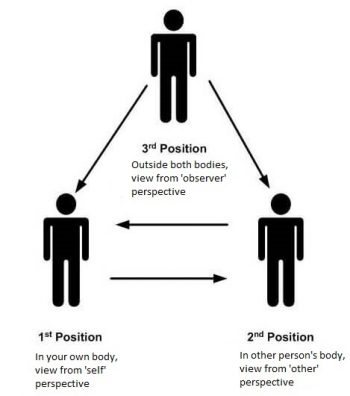
The three perceptual positions are:
To looking at the issue of debate or opportunity from your own perspective which is easiest of the three as this is the default position
Is to change our perspective and look at the situation or challenge from the eyes or paradigm of the other person or organization – this will be more challenging to do
This takes practice and centers on looking at the situation from a neutral position or imaging yourself as a fly on the wall observing the situation from both or a variety of perspectives which will take solitude, concentration and visualization
By going through these three positions, it will help you to understand the motivations and perspective of others. This will enable us to make more grounded considered decisions and taking more measured actions.
Win/Win Steven Covey’s classic habit:
The Three Perceptual Positions approach can be intertwined with Steven Covey Win/Win Habit. In that it’s best in life that for the more significant matters of importance is for both parties to aim for solution or a decision in which both parties come away from the situation feeling that they have had their needs considered and met.
Sadly, in life many aim for Win/ Lose in which they win and the other party loses. This is ok in competitive team sports vs another team. However in most other situations this outcome could result with one party leaving the table disgruntled and in the longer term the relationship or outcome may not be concrete or sustainable.
The final scenario which is arguably the most least desired is Lose/Win or a martyrdom agreement. This can cause personal difficulty, suffering and is likely to generate a lot of potential moaning and frustration.
I hope you find this blog and my video recorded last year helpful. Please feel free to comment or reach out to me if you have any questions.
At this time of year many of us will be evaluating our successes and challenges that we have navigated throughout 2021. People attempt to set new goals and objectives for the new year. Some of us are really disciplined and have developed great strategies. However, many will embark on these goals with great determination but within a few weeks into the new year, these goals will be pushed aside for a variety of reasons.
Based on my experience as a Life Coach, I hope the below will identify some of the reasons these resolutions and goals are left unobtained. Even if just a couple of the tips below are utilised, this will help you on the way to achieving some of your goals in 2022.
Poorly framed goals that are structured in the negative
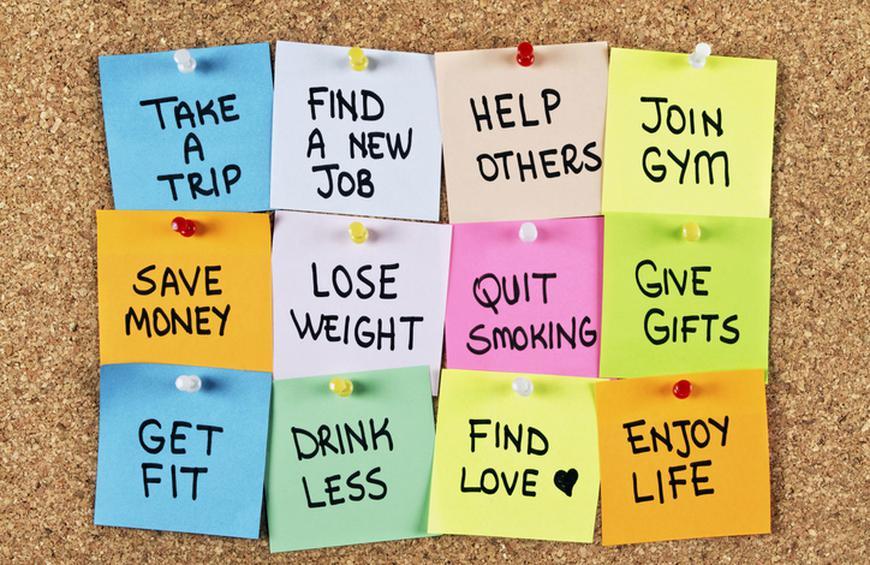
The chance of succeeding is significantly stronger by focusing on what we want to achieve in the positive rather than a goal phrased in the negative E.g. “I want to give up smoking” and “I want to lose weight”.
It would be better to rephrase this as, “I want to focus on embarking on a healthy lifestyle for me and my family for 2022”
Begin With The End in Mind and Visualization
What is it going to be like when I achieve this goal?
Why is this resolution important to me?
What will be my weekly and daily plan to achieve this objective?
What blockers are there I need to overcome; is this my husband or partner
What resources will I need?
If you can’t answer the above or crystalize a powerful vision of the future of attaining this goal, you will not have the energy to keep going when things go wrong as in all quests or journey to achieve a goal
Eat That Frog- Brian Tracy
What is the hardest step I could take each day to hit my goal?
Choosing to do this and tackle part of the trickiest goal first thing each morning will give you the energy and momentum to achieve
Little Rewards and Milestones
Those that have little rewards for the smaller milestones are more likely to keep going
Perhaps for every single cigarette box or capsule not smoked means a couple of quid saved in a jar for something positive
Tea cake reward for two pages written of your future number best seller
Battle With The Inner Critic vs The Inner Coach
The mind can be for you or against you
Need to be aware of the conversations with yourself “You are not good enough”, “stay in your lane”, “you have failed in the past you will fail again”
These are a range of negative thoughts that can arise from conversations with yourself
Action illusion- lots of talk of doing and want to act but a lack of action
Fear of Failure – If I don’t try then I won’t fail and let myself or others down
I’ll do this goal when I feel better
Right feelings come after right actions; even a little step each day can help to create momentum
Lack of Understanding of Stinky Kippers – Limited Beliefs – Kain Ramsey
Many are unaware of our hidden beliefs that are in the background subconsciously driving us daily
There are typically 15-20 stinky kippers/limited beliefs- some we can easily identify and others will take some discovery, deep thinking, questioning and possibly discovery or self-reflection with a coach to unearth and tackle further
These are often formed at the age of 4-11 based on life experiences or interactions with friends or family
Takes 3-4 situations during this phase that form a belief that are buried without knowledge
Despite these being negative we will often fight to maintain these limitations subconsciously
These hidden chains will subconsciously pull you down
May be worth working with a life coach or deep thinking or evaluation exercises to flesh out these gremlins
Birds of Feather – Lack of Accountability Partner
If you want to be successful in an area or achieve a goal it will help to have network of others that have successfully been on the journey and are successful positive forces – recommend by Les Brown and Brian Tracy
If you have a reference group that you lean on that doesn’t share a passion for personal improvement or endorse your goal, it’s likely your journey will become even more challenging
Having a coach, mate or colleague for a monthly or regular catch-up will give you more energy to hold you accountable giving you a cadence point
This needs to be someone that is empathic not sympathetic as this will help to hold you to account on the journey to achieving your goal
Not being honest about your progress
Need to develop a mindset and to become brutally honest about your progress and actions each week
Many people often don’t like criticism as we don’t like to be wrong
To achieve our goals we need to be a little better at being able to objectively deal with the truth of our progress
Need to avoid becoming the BSE syndrome – Blame Someone Else – Paul McGee Sumo
Dealing with Setbacks-Solution driven not problem focused
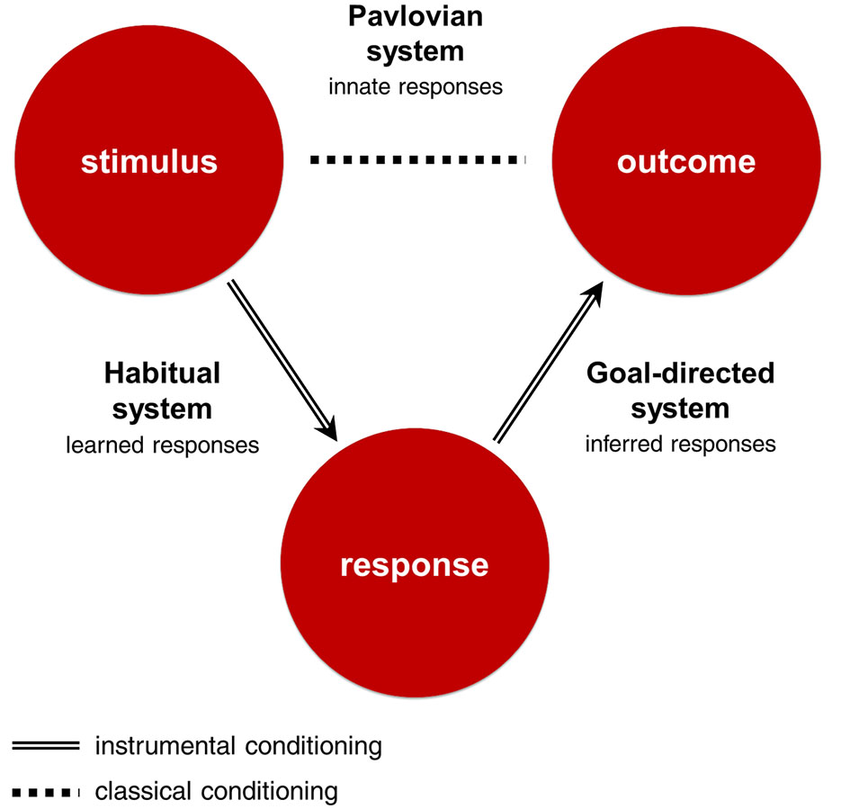
Simple equation in life that has been coined from the great book Man’s Search For Meaning
Situation + Response = Outcome vs Situation = Outcome
Many in life are unaware that there is always a small action in our control to tackle a bad situation. We always have some ability to control our response to our thoughts or unpredicted circumstance
What is this unexpected situation or setback asking of me rather than asking what am I asking of this situation?
First 90 days
Repetition and continuous application for something to become a habit and become burned into our mindset
If you can get to 90 days, the chance of success improves and maintaining traction dramatically increases
Re-assess goals
Often with slimmer’s they have great initial goal and make solid progress but once their body adapts or gets to a point it becomes difficult to maintain the same rate of progress
It’s important at this stage to adapt fitness or goals to maintain momentum
Feel free to explore some of the authors, sources or feel free to reach out to me if you feel you need a coach or accountability partner to help achieving your goals for 2022.
Circles of Influence is adapted from Julian Rotter’s great work.
The more we focus on what we can control and influence daily the more empowered and positive focused we become.
6 Morning Habits is based on Hal Elrod’s research based on successful business people and sports professionals.
Video Summary:
Locus of Control as a principle was originated by Julian Rotter in 1954. It considers the tendency of people to believe that control resides internally within them, or externally, with others or the situation. Note that, like other preferences, this is a spectrum. Some people have a wholly internal or external Locus of Control, but many will have some balance for both views, varying with situation.
6 Morning Habits are adapted from Hal Elrod’s work:
1. Commitment to some Yoga, meditation or stillness
2. 5-10 minutes each morning writing down our goals and objectives for the day
3. Chanting an affirmation to ourselves in the mirror on what our long term objectives and major weekly goals are reiterated each day
4. What are the top 5 most important things we need to do each day?
5. Review of three things that went well the day before, some gratefulness on what’s good in our lives or achievements from day before. It’s often easy to lose sight of the good things if we are not reflective daily.
6. Some exercise for 15-20 minutes each day helps to keep us fit, increase our serotonin levels and improve our mood. Other benefits is that it helps to make us feel more in control and boost our confidence.






 EldonLifeCoach.com